



Project Objectives
Project progress
The project began in September 2020. Qualitatively entered primary data: address data (the database in OS is filled with correct coordinates after correction in TMS), delivery time windows, dimensional characteristics of goods and other information.
The ability to exchange information between the accounting system and the Transportation Management System (TMS) has been implemented. This data exchange includes transferring information on orders, vehicle availability, and route plans between the accounting system and the TMS. Also, the mobile application was modified for couriers; the carrier did not have access to the customer’s phone number, and all calls were made exclusively through the application. This allowed us to ensure the confidentiality of data.
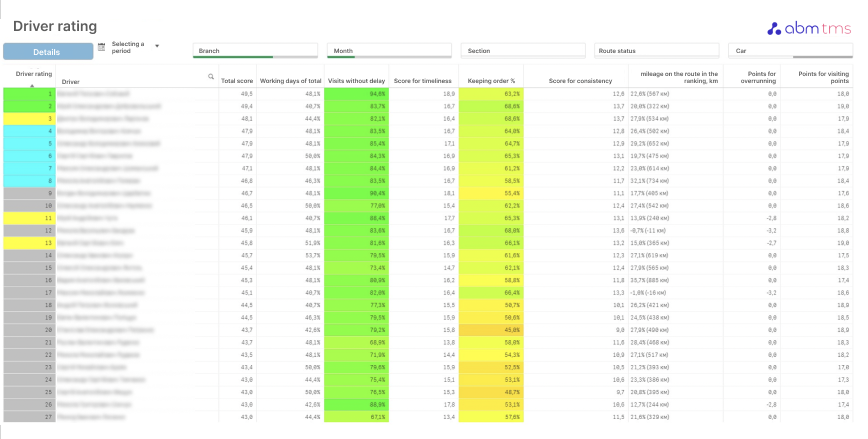
It was important to understand mall efficiency, driver efficiency, and scheduling dispatcher efficiency.
Support during initial planning, conducting plan-to-fact route execution analyses, and explaining how to work with new dashboards and analytics.
ABM TMS solutions for Epicenter K


Implementation results
ABM TMS


-
The NPS grew to 85.7%.
-
Increasing logistician productivity and minimizing the «human factor» and adaptation time of new employees
-
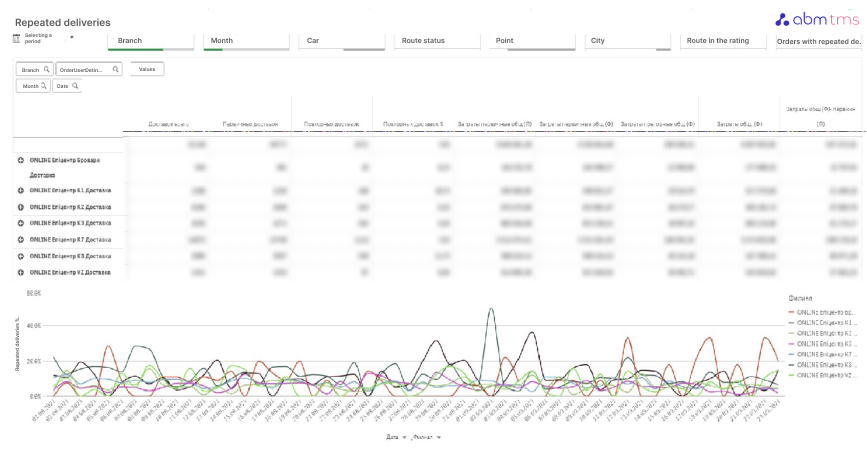
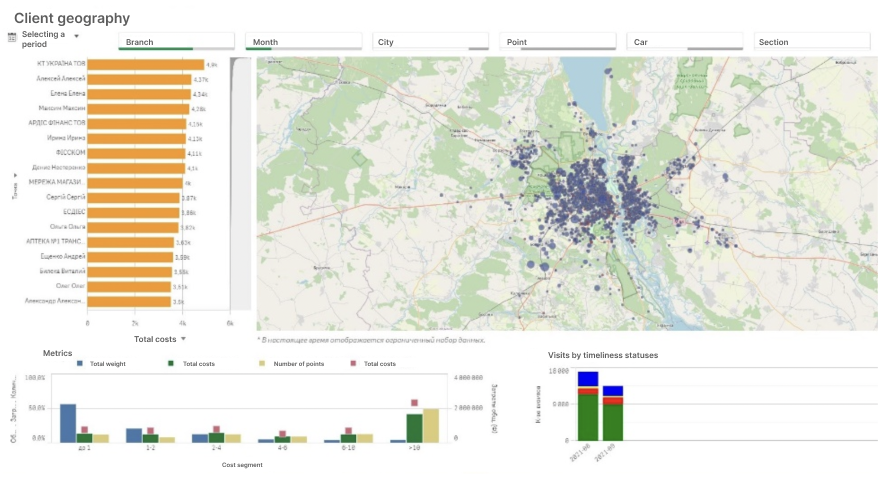
Availability of information on dispatcher and driver KPIs through analytics
-
Scheduling of service tasks for drivers (service stations, gas stations, etc.)
-
Using the functionality of the mobile application: electronic route list, route navigation
-
Analytics module
-
Transparent and rationed automatic routing – minimizing overloading of vehicles, delays, overruns
-
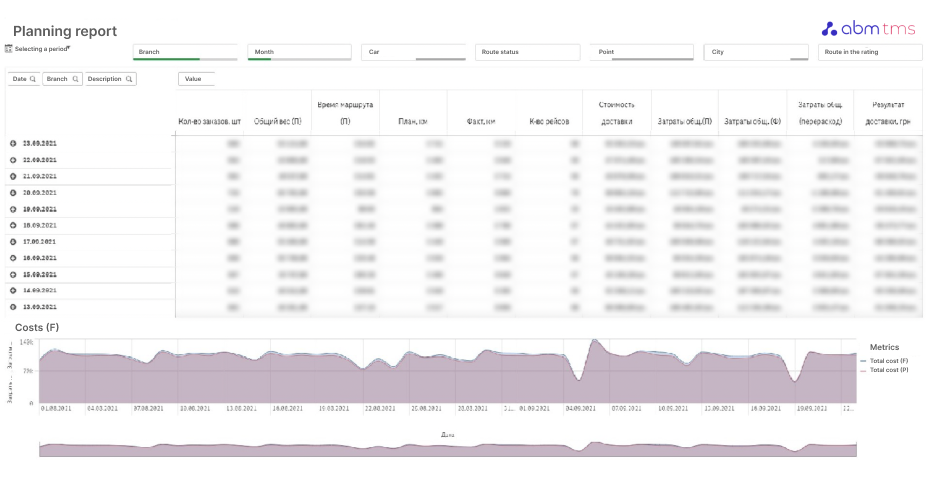
Availability of information about the plan-fact of flight fulfillment (fact with GPS), history of car operation and forecast of delays
-
Thanks to the reduction of the delivery window from 4 to 2 hours, the delivery rate grew from 48% to 54%.
We appreciate that you are interested in our products. One of our staff will be in touch with you shortly. Have a great day!
FAQ
Can the analytics be customized to meet a company’s specific needs?
Yes, the analytics module is fully customizable to meet the client’s requirements. For “Epicenter K,” dashboards were configured to evaluate the performance of shopping centers, drivers, and dispatchers – with the ability to track planned versus actual trip completion, vehicle history, and delay forecasts.
Does the system ensure the confidentiality of customer data during delivery?
Yes. For “Epicenter K,” the mobile app was configured so that the driver cannot see the customer’s phone number – all calls are made exclusively through the app. This is a standard feature of ABM Rinkai TMS for companies that prioritize protecting customers’ personal data during delivery.
Is the system suitable for chains with a large and diverse fleet (trucks + passenger cars)?
Yes, ABM Rinkai TMS is designed to handle mixed fleets and large-scale chains. In the “Epicenter K” case study, the system manages 390 trucks and 230 passenger cars serving 78 shopping centers, automatically factoring in the dimensions of both vehicles and goods when planning routes.