



Background and Challenges


Project Goals
We appreciate that you are interested in our products. One of our staff will be in touch with you shortly. Have a great day!
Why ABM Inventory
This approach allowed the chain to move from manual control of every single order to systematic inventory management that remains manageable even during active opening of new outlets.
-
ABM Inventory — the core system: based on built-in algorithms for handling goods at storage locations, it is responsible for automatically generating orders for stores and the distribution center based on demand forecasts and replenishment parameters.
-
Separate additional modules — Fresh and PromoTools: Fresh adapts calculations to the specifics of short-shelf-life products, while PromoTools forecasts demand for upcoming promotions and accounts for the increased need during a promotion.
How the Implementation Went
The implementation of ABM Inventory for BABAK took 9 months — from project kickoff to full transition to operational mode, and the system generated its first automatic order after just 4.5 months from the start of work
We appreciate that you are interested in our products. One of our staff will be in touch with you shortly. Have a great day!
What This Looks Like in Inventory:
-
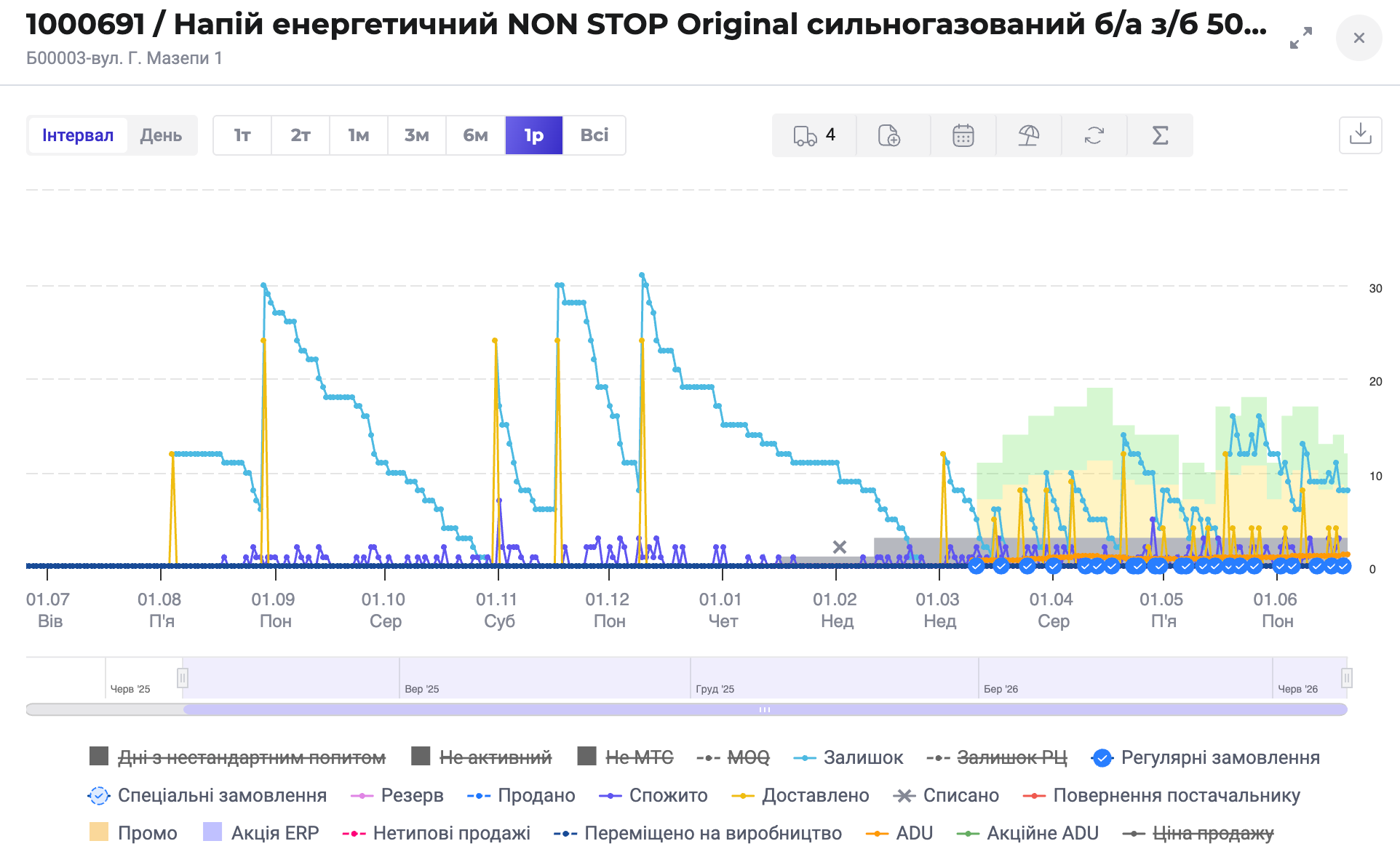
Examples from the system's reports for specific SKUs, showing how order behavior changed after the transition to automatic replenishment.
Starting March 2026, after the transition to auto-ordering, deliveries became regular (marked with checkmarks) and uniform in volume.
Business Results
The implementation of ABM Inventory allowed BABAK to move from manual order planning to automated inventory management. The main effect was achieved through more accurate forecasting, order automation, and better turnover control.
-
Over 100 automatic orders are generated daily, with a team of just two purchasing managers overseeing the entire assortment across all stores and the distribution center.
-
The planner’s morning now starts with Inventory: orders that used to be created manually are now generated automatically by the system in minutes.
-
After connecting PromoTools, the team received help calculating promotion-related needs — these calculations are compared against category managers’ manual estimates.
-
In their day-to-day work, category managers and purchasing managers most often use the LFL analysis, “Reasons for Lost Sales,” “Suppliers,” ABCD, OTIF, Fresh, and “Questionable Stock” reports.
-
Worth noting separately is the planner’s increased confidence in their work and improved communication with suppliers regarding service level.
We appreciate that you are interested in our products. One of our staff will be in touch with you shortly. Have a great day!