


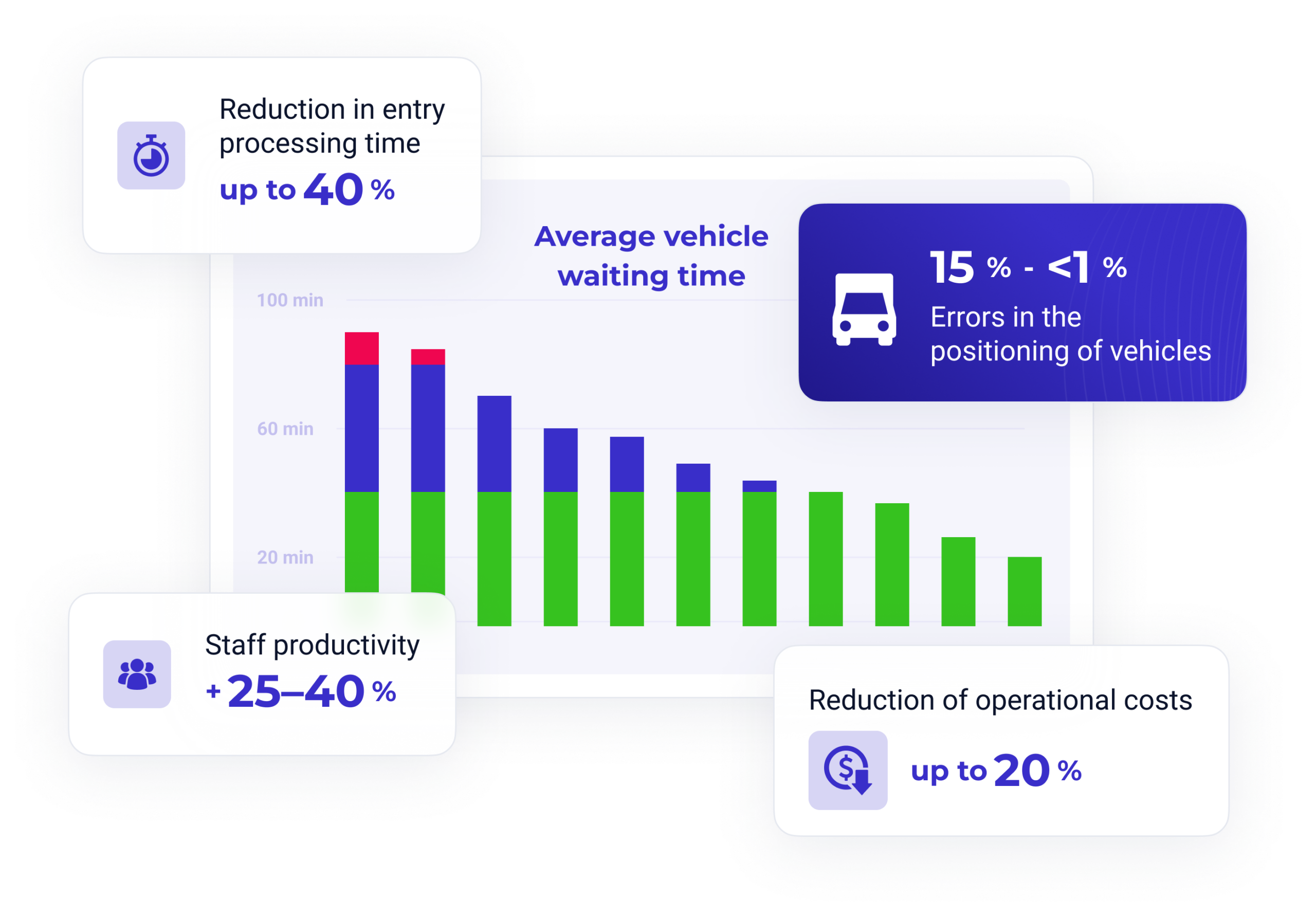
Effects of Implementing the Yard Management System
The YMS warehouse yard management system directly helps reduce logistics costs and improve overall operational efficiency.


What tasks does the Yard Management System perform?
Efficient Use of Warehouse and Distribution Center Space
minimizing traffic congestion and disruptions to delivery and shipping schedules
Ensuring an organized loading and unloading process,
which reduces vehicle downtime and improves the overall efficiency of logistics operations
Access Control to the Warehouse Premises
allows for tracking the movement of vehicles and cargo, thereby enhancing security at the warehouse
Reduction in Operating Expenses
through the optimization of staff working hours, the number of employees involved, and a reduction in the costs associated with loading and unloading processes
Ability to Register a Vehicle,
create electronic queues, notify drivers of trip assignments, loading, and unloading, and manage document distribution
Integration of the YMS System with WMS/TMS/ERP
Coordinated logistics management at every stage of the supply chain
The YMS helps companies of various sizes and across various industries
-
 Large Warehouses and Logistics Centers
-
Manufacturing facilities with high cargo throughput
-
Retail companies with high delivery volumes
-
Ports, Terminals, Hubs




Yard Management System Features

-
The program allows to manage
automated processing of technical specifications via an electronic queue
-
Improves entry efficiency
and cargo transportation services
-
Creates conditions
for accurate planning of ramp operations

-
The system helps effectively
сoordinate transportation in the area around the company's warehouse
-
Provides control
moving a vehicle from the entrance to the ramp
-
Coordinates transportation operations
in real time
-
Managing Unplanned Transportation:
Queuing

-
The system helps create
and manage time slots for vehicle service
-
Allows book in advance
dock, arrival time, and type of operation (loading/unloading)
-
Ensures accurate planning of logistics slots
and reduces conflicts over resources
-
Complete control over the situation in the yard
number of vehicles, location, and status

-
The system provides comprehensive analytics
and monitoring the progress of transport reserve processing
-
Displays scheduled and actual
arrival, departure, and service time metrics
-
Allows track delays
in arrival, start of work, and shipment
-
Improves process transparency
and monitoring compliance with logistics slots
-
Facilitates a rapid response
on deviations in schedules and dock operations optimization

-
The system monitors
the stages of a logistics visit
-
Shows the sequence of all stages in the transportation process
from planning to departure
-
Each entry includes
the status, start and end times of the phase, as well as its duration
-
Helps identify “bottlenecks” and service disruptions
for example, getting stuck in the “Inactive” or “Pending” status
-
Promotes logistics transparency
accurate reporting, and improved warehouse performance KPIs

-
Visual representation of the parking spaces
occupied by vehicles in the courtyard
-
Monitoring the Availability and Location of Vehicles
in real time
-
Ensuring Optimal Use of Space
on the Premises
-
Improving Accuracy and transparency
of resource management and logistics processes
-
Quick Access to Information
for making timely decisions

-
Smart and Flexible Scheduling for Carriers and Drivers
based on actual operational needs
-
Visual monitoring of changes, routes, and driver assignments
with status indicators—scheduled, in progress, completed
-
Provides visibility into the precise distribution of tasks
by category and location, taking into account time and duration
-
Optimizes the workload on the warehouse and transportation,
improving the efficiency and convenience of logistics management

-
Manages all key points along the route:
gate, car wash, parking lot
-
Provides quick access
and completing the necessary paperwork right from your phone
-
Integration with Scales
for automatic weighing of cargo
-
Improves efficiency and accuracy
performing tasks on site
-
Improves driver efficiency
and reduces downtime












































Stages of Implementing the Yard Management System
The YMS is implemented in three key phases, after which full support is provided
01 Audit and Design Project Preparation
02 Preparing ABM YMS for Launch
03 Launch of the ABM YMS
04 Support
Average duration of the stage 15-25 days
Average duration of the stage 60-65 days
Average duration of the stage 10-20 days
On an ongoing basis
We appreciate your interest in our products. An ABM Cloud representative will contact you shortly. Have a great day!
Frequently Asked Questions
Everything You Need to Know About the YMS Warehouse Yard Management System
1. What is a Yard Management System?
A Yard Management System (YMS) is software designed to optimize the management of processes within a warehouse, transportation hub, or distribution center.
It helps track vehicle movements, manage parking, loading, and unloading, and allocate tasks among loading zones.
YMS manages the warehouse yard and helps improve operational efficiency, minimize delays, and enhance coordination between warehouses and transportation companies. This, in turn, contributes to improved overall logistics and reduced operating costs.
2. How to Choose a YMS for Your Business: Key Criteria
Below are the key criteria to consider when selecting a yard management system for logistics:
- Integration with other systems
- API support or pre-built connectors to: WMS (Warehouse Management System), TMS (Transportation Management System), ERP (SAP, Microsoft NAV)
- Flexibility in time management
- Slot reservations by carriers
- Automatic scheduling of time slots based on cargo type or supplier
- Mobility and scanning
- Support for QR codes/barcodes, GPS
- Mobile app or web portal for drivers
- Yard and space visualization
- Map showing the location of docks, ramps, and parking areas
- Real-time display of occupancy and status
- Reports and KPIs
- Wait times, downtime, average service time
- Number of schedule violations
3. What external devices can be integrated with the ABM YMS to improve management of the surrounding area?
ABM YMS can be integrated with a range of external devices to improve management of the surrounding area, specifically:
- Barriers and electronic gates—for automatic control of vehicle entry and exit;
- QR/barcode scanners—for identifying drivers and cargo;
- Information kiosks or tablets at checkpoints—for recording arrivals;
- Traffic lights and sensors—for managing traffic flow within the yard.
4. For which companies would implementing a YMS be particularly beneficial?
Implementing a Yard Management System (YMS) is particularly beneficial for companies that operate large warehouses, distribution centers, or transportation hubs.
This solution is ideal for logistics companies that need to minimize downtime. YMS will also be useful for retail chains to improve coordination between warehouses and points of sale, and it will help manufacturing companies optimize their shipping and material delivery processes.
Transportation and freight forwarding companies will be able to effectively monitor cargo flows and organize parking.
Retail chains with high turnover will also benefit from using YMS to manage multiple loading and unloading points.
Overall, the YMS system helps improve yard logistics management, speed up processes, and reduce the costs of managing the freight yard.