How to Plan Inventory for Promotions Using AI
Planning inventory for promotions is one of the most complex challenges in retail. A mistake in demand forecasting can lead either to stockouts and lost sales or to excess inventory and markdowns after the promotion ends.
In modern retail, demand is influenced by dozens of factors. As a result, traditional planning approaches no longer provide sufficient accuracy. That’s why more companies are adopting ML models and AI-driven solutions for demand forecasting and inventory optimization — such as inventory management systems like ABM Inventory.
However, the key challenge is not only to generate an accurate forecast, but also to understand its logic before making decisions.
In this article, we’ll cover:
- why promotion planning is so complex
- where traditional approaches fall short
- how AI helps reduce risks before a promotion even starts
Why Promotion Inventory Planning Is So Challenging
During promotions, demand becomes volatile and depends on multiple variables:
- discount depth
- promotion mechanics (BOGO, fixed price, bundles)
- number of SKUs in the promotion
- cannibalization between products
- halo effect across categories
- seasonality and external factors
In such conditions, even experienced category managers struggle to accurately forecast demand and determine the right stock levels.
Typical consequences of poor planning:
- stockouts during promotions
- excess inventory after promotions
- lost sales
- increased write-offs
Why Traditional Forecasting Approaches Fall Short
Many retailers still rely on simplified methods:
- average-based calculations
- relying only on past promotions
- lack of structured factor analysis
These approaches don’t scale and fail to capture the complexity of real demand patterns.
ML models address this by incorporating dozens of variables and producing more accurate forecasts.
But this introduces a new challenge.
The Key Problem with ML Forecasting: Accuracy Without Explanation
ML models significantly improve forecast accuracy — but they also make the logic harder to interpret.
In many systems, forecasts act as a “black box”: you get the result, but not the reasoning behind it.
This creates real business risks:
- difficult to validate forecasts before launch
- hard to detect data issues quickly
- unclear which factors drive results
- reduced trust in the forecast
As a result, even accurate forecasts are often underutilized.
How AI Improves Promotion Inventory Planning
AI, combined with ML, not only generates forecasts but also improves decision-making.
Modern solutions enable retailers to:
- analyze historical promotions
- predict demand uplift
- consider multiple influencing factors
- identify relevant promotion analogs
- generate data-driven ordering recommendations
AI transforms forecasting from a number into a decision-making tool.
ML answers the question “what will happen”, Agentic AI answers “why it will happen and what to do about it.”
What Is Agentic AI
Agentic AI is an AI assistant that helps interpret ML forecasts, explain their logic, and validate decisions before execution.
Unlike traditional AI tools that only generate predictions, Agentic AI focuses on:
- explanation
- control
- interaction
How Agentic AI Helps You Make Better Decisions
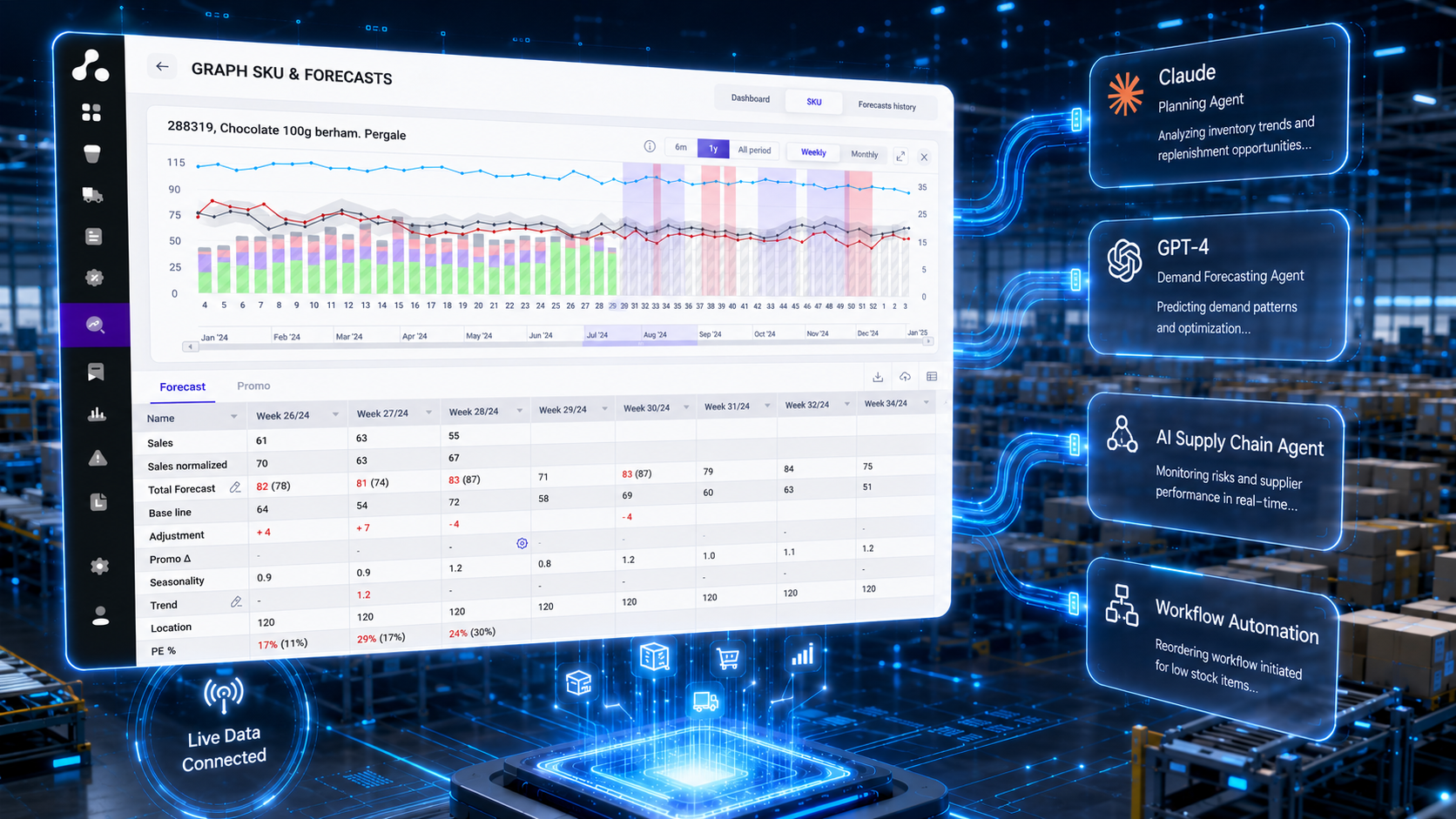
To make forecasts transparent and actionable, the Agentic AI approach is implemented within the inventory management system ABM Inventory.
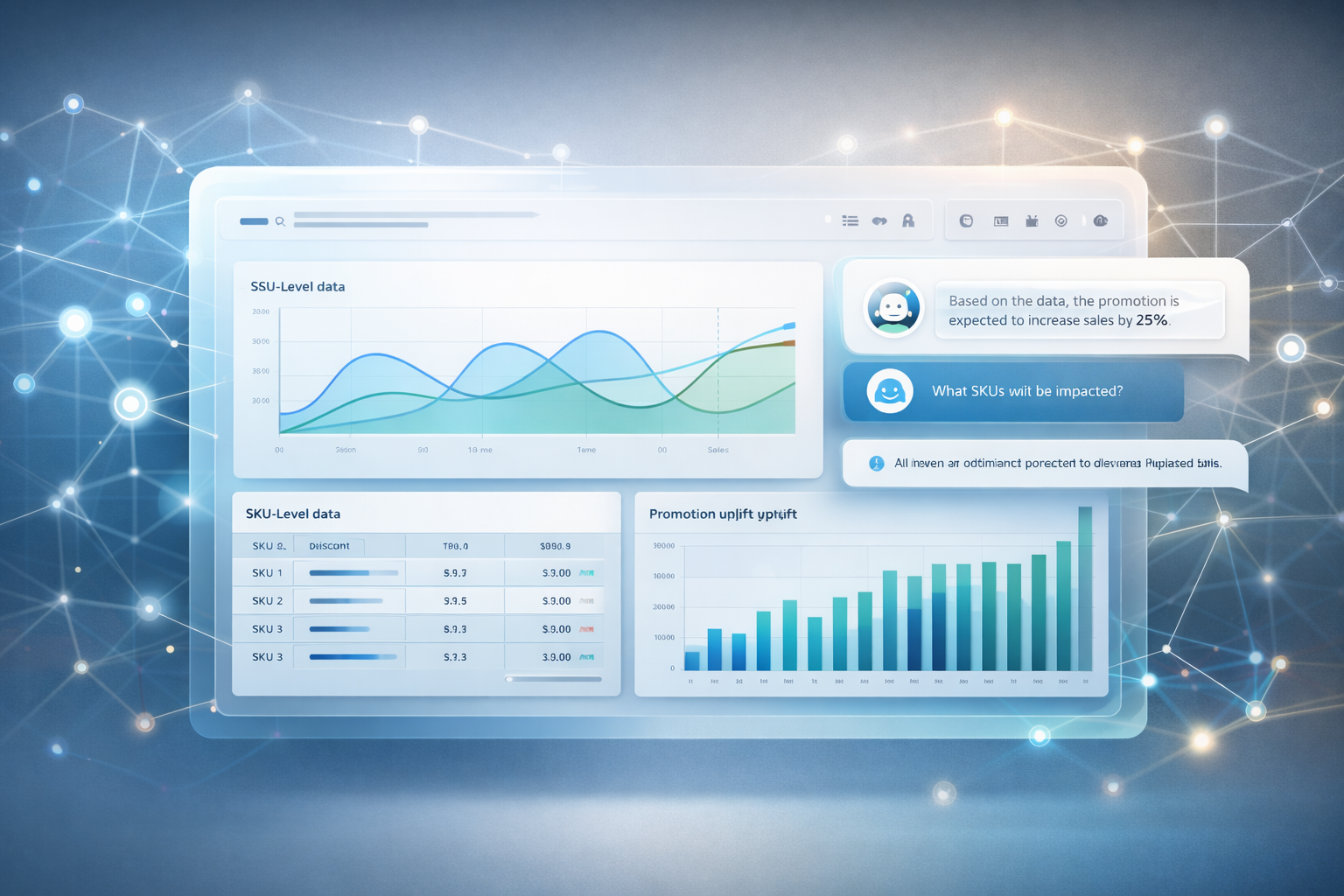
It enables users to work with forecasts in a conversational way:
- ask questions about the forecast
- understand influencing factors
- validate decisions before execution
Agentic AI does not replace the user.
It helps them understand and validate forecasts before acting.
With Agentic AI, users can:
- get explanations of demand forecasts
- analyze key influencing factors
- test assumptions
- detect data errors before launch
- find relevant analogs
Instead of just a number, users gain understanding.
How It Works in Practice
ПIn promotion planning, Agentic AI helps:
- analyze forecasts at SKU, store, or location level
- evaluate factor impact
- identify anomalies
- validate input data
- reduce risks before launch
As a result, decisions are based on logic and data — not intuition.
How to Plan Promotion Inventory Using AI
A typical process looks like this:
- Analyze historical promotions
- Forecast demand using key factors
- Estimate expected uplift
- Validate forecasts and assumptions
- Identify risks and data issues
- Calculate optimal order quantities
AI automates these steps, while Agentic AI ensures the results are understood and validated.
Business Impact
Using ML and AI for promotion planning enables companies to:
- reduce stockouts during promotions
- minimize excess inventory
- decrease write-offs
- improve forecast accuracy
- make more confident, data-driven decisions
Conclusion
Promotion inventory planning can no longer rely on intuition or simplified models.
ML has become the standard for accuracy. Agentic AI adds a new layer — understanding and control.
Together, they enable better, faster, and more confident decision-making.
FAQ
How can you avoid stockouts during promotions?
Use ML-based forecasting, consider all promotion factors, and validate forecasts before launch.
How does AI forecast demand during promotions?
AI analyzes historical data, incorporates multiple factors, and predicts demand uplift.
Why do users distrust ML forecasts?
Because they often lack explanation — results are given without transparency.
What is Agentic AI?
An AI approach that not only generates forecasts but also explains and validates them.
Can AI replace human decision-making?
No. AI enhances decision-making, but final decisions remain with the user.
How can you reduce out-of-stock risks?
Use ML forecasting, factor in all variables, and validate data before execution.