

Why Source of Supply Decisions Impact Profitability
In most retail operations, supply decisions are more complex than they seem. A single SKU may have multiple suppliers and multiple warehouses — each with different conditions.
As a result, managers spend time manually comparing prices, lead times, and stock levels, making decisions based on experience or intuition, and working across multiple spreadsheets.
This leads to stockouts in stores, excess inventory in warehouses, increased logistics costs, and products that remain unsold.
How Automated Source of Supply Selection Works
Automatic Source Selection for Replenishment
ABM Inventory automatically determines the optimal source of supply — whether an external supplier or an internal warehouse — based on product availability, delivery speed, cost, and service level.
Intelligent Evaluation and Ranking of Supply Sources
The system analyzes key parameters and ranks supply sources based on the weighted importance of each criterion.
Flexible Purchasing and Logistics Optimization
For each SKU, the system selects the supplier or warehouse at the distribution center or store level. This helps reduce transportation costs, balance inventory across locations, and minimize stockouts and overstocks.
How the System Selects the Best Source of Supply
ABM Inventory evaluates all available supply sources — both external suppliers and internal warehouses — and selects the optimal option based on a combination of factors.
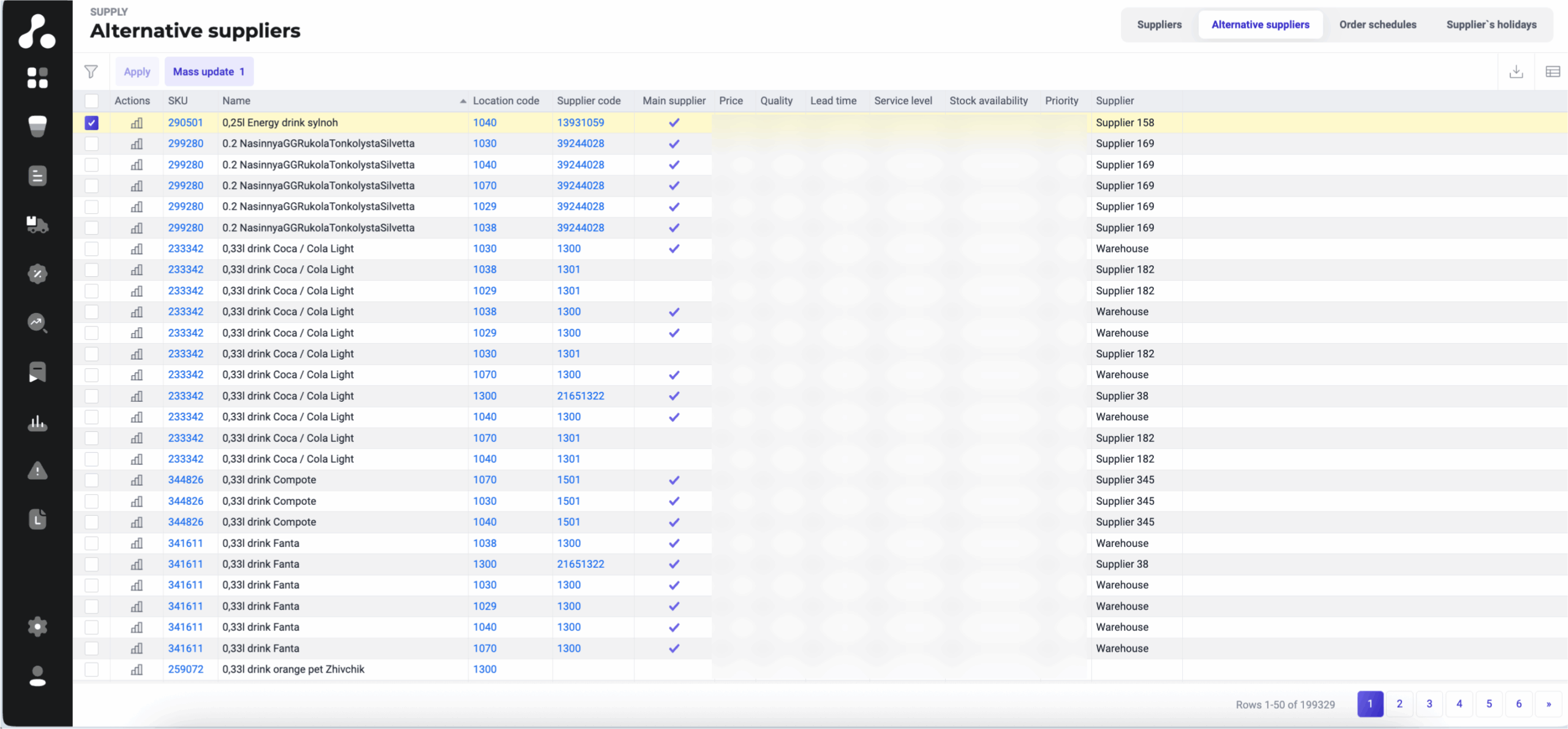
What Factors Are Considered
- purchase price
- lead time
- service level (SLA, OTIF)
- product availability
- warehouse stock levels
- logistics costs and distance
- regional demand
How the Decision Is Made
Each option is scored based on defined criteria and their assigned weights. The system compares all available sources and automatically selects the optimal option for each order.
Decisions are made automatically — based on data, not intuition.
Business Impact of Automated Source Selection
Automating source of supply decisions directly improves financial performance:
Fewer stockouts → increased sales
Better purchasing conditions → higher margins
Optimized logistics → lower costs
Balanced inventory across locations
Reduced write-offs and dead stock
Faster decisions without manual effort
Frequently Asked Questions
How does the system select a supplier?
The system evaluates suppliers based on key criteria (price, lead time, service level, availability) and selects the optimal option based on defined priorities.
How is the warehouse selected for fulfillment?
The algorithm analyzes stock levels, logistics, demand, and costs to choose the warehouse with the best balance of speed and cost.
Can we define our own rules and priorities?
Yes, users can configure selection criteria and assign weights based on business goals.
Can the process be fully automated?
Yes, the system can operate in both recommendation mode and fully automated mode.
How is this different from an ERP system?
ERP systems display data. ABM Inventory makes decisions — automatically and based on multiple factors.
We appreciate that you are interested in our products. One of our staff will be in touch with you shortly. Have a great day!